Restaurant POS Total Cost of Ownership: The Five-Year Math
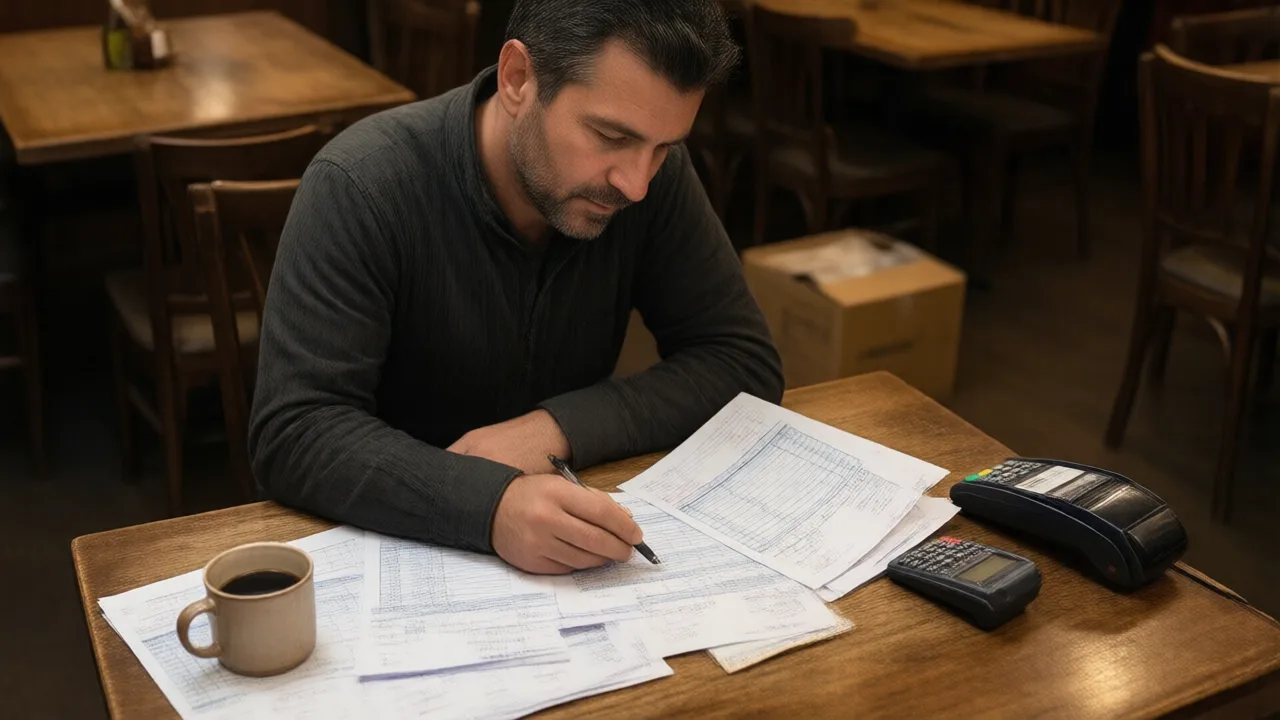
The quote says $89 a month. That's the number that goes in the spreadsheet, gets compared against two competitors, and wins the deal. Five years later the owner adds up what the system actually cost and the figure is somewhere north of $70,000.
Nobody lied. The $89 was real. It just described about 12 percent of the total.
This is the most consistent budgeting mistake in restaurant technology, and it's not a small one. Restaurants run on net margins of roughly 3 to 6 percent, which means a $10,000 cost overrun on a POS decision has to be paid back with $170,000 to $330,000 in additional sales. Getting the model wrong doesn't just cost money — it costs a year of growth to fix.
What makes it worse is that the error compounds silently. Processing rates don't appear on a monthly invoice you scrutinize; they come out of each deposit. Integration fees show up one at a time. Hardware replacement arrives in year three as an "unexpected" expense that was always going to happen. By the time the picture is clear, you're two years into a contract with an early-termination clause.
So let's build the whole model. Every line, with real 2026 numbers.
The Seven Cost Buckets Nobody Puts on One Page
A complete POS TCO model has seven components. Most quotes cover two.
1. Hardware — $3,500 to $18,000 up front
A single counter station with terminal, cash drawer, receipt printer and card reader lands around $1,400 to $2,600. A full-service floor with three stations, two handhelds, a kitchen display and a receipt printer per station runs $8,000 to $14,000. Add a self-service kiosk and you're looking at $3,000 to $5,000 more per unit.
Leasing changes the shape but rarely the total. A $12,000 hardware package on a 48-month lease at typical restaurant-equipment rates comes to roughly $310 a month, or $14,880 — about 24 percent more than buying, in exchange for preserving working capital. That's a legitimate trade, not a trap, as long as you count it correctly. Our restaurant POS hardware guide breaks down what each station actually needs.
2. Software subscription — $1,200 to $12,000 per year
Here's where the advertised number hides the most. Watch for per-terminal pricing: a $79/month base that covers one station becomes $316/month across four. Watch also for module pricing — online ordering, loyalty, inventory and reporting are frequently separate line items at $25 to $89 each.
3. Payment processing — the elephant
This is the line that decides the winner, and it's almost never in the comparison spreadsheet.
Take a restaurant doing $1.2M a year with 85 percent on cards — about $1,020,000 in card volume. At an all-in effective rate of 2.9 percent, that's $29,580 a year. At 2.65 percent, it's $27,030. The 0.25-point difference is $2,550 annually and $12,750 across five years.
Put differently: a quarter of a percent on processing outweighs the entire difference between the cheapest and most expensive software subscription on your shortlist. If you read one thing before signing, make it our breakdown of restaurant payment processing fees — specifically the section on how interchange-plus differs from flat-rate pricing, because the comparison is not apples to apples.
4. Integrations and API access — $0 to $3,600 per year
Accounting sync, delivery aggregation, scheduling, loyalty and reservations each may carry a monthly fee of $15 to $60, or sit behind an API tier at $25 to $100 per location per month. Four integrations at $40 is $1,920 a year — real money that never appeared in the quote.
5. Support and compliance — $360 to $2,400 per year
Basic support is usually included; 24/7 phone support with a guaranteed response window is often a premium tier at $30 to $150 a month. Add PCI compliance program fees, commonly $99 to $199 annually, and a non-compliance penalty of $20 to $40 a month if you never complete the questionnaire. That last one catches a startling number of restaurants.
6. Hardware replacement — the year-three surprise
Fixed terminals last 5 to 7 years. Handhelds and kitchen devices last 2 to 4 — they get dropped, greased and heat-cycled. Card readers frequently need replacement at 3 to 5 years as security standards move. A realistic five-year model assumes one full replacement cycle on mobile devices and readers: budget 30 to 45 percent of your original hardware spend as a year-three line. The durability differences are covered in our POS hardware durability comparison.
7. Labor: implementation, training and exit
Menu build for a 120-item restaurant with modifiers is 15 to 30 hours of somebody's time. Staff training averages 2 to 4 hours per employee; at 25 employees and $18 an hour, that's $900 to $1,800 per rollout, and restaurant turnover means you'll re-train a meaningful share every year. Then there's the exit: migrating off a system costs 20 to 60 hours of management time plus whatever the vendor charges for a data export.
The Full Five-Year Model
Here's a realistic build for a single-location full-service restaurant doing $1.2M annually, four terminals, two handhelds, one kitchen display.
| Line item | Five-year cost | Notes |
|---|---|---|
| Hardware (initial) | $11,400 | 4 stations, 2 handhelds, 1 KDS |
| Hardware replacement (yr 3) | $4,200 | Handhelds + card readers |
| Software subscription | $16,740 | $279/mo blended with modules |
| Payment processing | $147,900 | 2.9% on $1.02M card volume/yr |
| Integrations | $7,200 | 3 connectors at $40/mo |
| Support + PCI | $4,500 | Premium tier + compliance |
| Training + implementation | $6,300 | Build, rollout, annual re-training |
| Migration reserve (exit) | $2,800 | Management time + export |
| Total, excluding processing | $53,140 | The number to compare vendors on |
| Total, all in | $201,040 | What the system truly costs |
Two things jump out. First, processing is 74 percent of the all-in figure — which is why negotiating your rate matters more than negotiating your software price. Second, even excluding processing, the true cost is roughly 3.2 times the software subscription alone. If you're only comparing subscriptions, you're comparing about a third of the decision.
Example scenario: two quotes for one 90-seat neighborhood restaurant
Illustrative scenario — a composite example built to show how the numbers work. It does not describe a real business or customer.
Consider a 90-seat neighborhood American restaurant doing about $1.1M whose owner has two quotes on the desk. Vendor A: $89 a month, flat 2.99 percent processing, hardware bundled at no cost on a 36-month agreement. Vendor B: $209 a month, interchange-plus processing landing at an effective 2.61 percent, hardware purchased outright for $9,800.
Vendor A looks $120 a month cheaper — $7,200 over five years. Suppose the owner nearly signs it.
The bookkeeper runs the processing math instead. On $935,000 in annual card volume, the 0.38-point spread is $3,553 a year, or $17,765 over five years. The free hardware carries an early-termination fee of $4,400 in the first 24 months and reverts to a $65-per-terminal monthly charge after month 36 — another $9,360 across four terminals for the final two years.
Adjusted five-year totals: Vendor A comes to roughly $71,300 excluding processing differences; Vendor B to about $58,700. Including the processing spread, Vendor B — the one that quoted more than twice the monthly price — is approximately $30,000 cheaper over the term. In this example the owner signs with B, and three years in, the actual variance from the model is under 6 percent.
Nine Questions That Surface the Hidden Costs
Ask these in writing, before you sign. A vendor who answers all nine plainly is one you can model accurately.
- Is pricing per location or per terminal? Get the price for your actual station count, not the base.
- Which features are modules? List every add-on with its monthly price.
- What is the effective processing rate on my volume and mix? Ask for a written estimate using your actual card mix, not a headline rate.
- Are gateway, batch, statement or PCI fees charged on top? These stack invisibly on top of the quoted percentage.
- What does each integration cost? Including any API access tier.
- What's the contract length and early termination fee? And does "free" hardware carry a clawback?
- What's the hardware warranty, and what does out-of-warranty replacement cost?
- What is included in support, and what's premium?
- What does leaving cost? Data export fees, notice period, hardware ownership on exit.
If you'd rather not build the model from scratch, this POS hardware cost calculator handles the equipment side with current pricing, and KwickPOS maintains a side-by-side comparison of major restaurant POS platforms that's a useful starting grid for the feature-versus-fee tradeoffs.
Know What You're Actually Paying
KwickOS puts POS, kiosks, online ordering and reporting on one platform with transparent pricing — so your five-year number matches the quote you signed.
Start Your Free Trial →Where the Savings Actually Live
Once the model is honest, the levers become obvious — and they aren't where most operators push.
Negotiate processing, not software. A 0.2-point improvement on $1M in card volume is $2,000 a year. Getting $30 a month off your subscription is $360. Spend your negotiating capital where the dollars are.
Buy hardware outright when you can. Leasing is roughly 20 to 30 percent more expensive over the term and often ties you to the vendor past the point you'd want to leave. If cash allows, own the boxes.
Count consolidation savings. A platform that includes online ordering and loyalty at $0 versus $89 a month elsewhere is worth $5,340 over five years — frequently more than the subscription gap between the two systems.
Model the exit before the entry. A system you can leave cheaply is worth paying slightly more for. Portability is a cost line, even if it never appears on an invoice. Our guide to POS cost breakdowns and hidden fees covers the contractual traps in detail.
The honest summary: POS pricing is not designed to be comparable. Vendors optimize different lines, and the one that looks cheapest on the page is frequently the one earning the most from you elsewhere. Build the five-year table once, fill it with written answers rather than sales-call estimates, and the right choice usually stops being a judgment call and becomes arithmetic.